

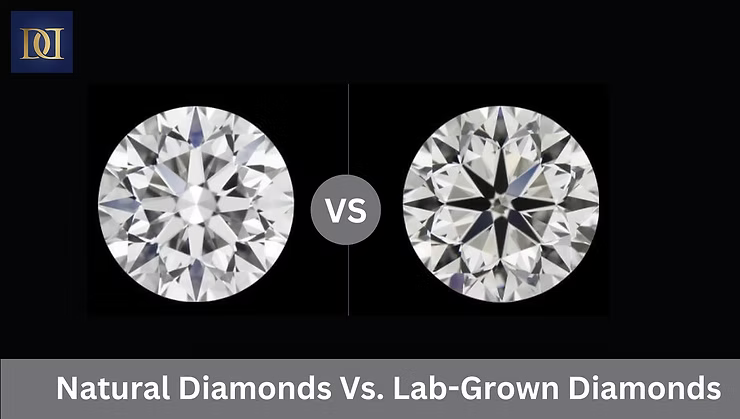
Natural Diamonds vs. Lab Grown Diamonds - Complete Guide
"Are lab-grown diamonds real diamonds?" It's the most common question our customers ask at our Gurgaon showroom. The short answer is yes. But the complete picture is far more interesting.
At Devi Diamonds, we've guided hundreds of buyers across Gurgaon, Delhi NCR, and beyond to make confident, informed diamond choices. In this guide, we break down every key difference between lab-grown and natural diamonds, covering quality, cost, ethics, and value, so you know exactly what you're buying.
What Is a Lab-Grown Diamond?
A lab-grown diamond, also called a lab-created diamond or synthetic diamond, is a diamond grown inside a controlled laboratory environment using advanced scientific processes. These diamonds are chemically, physically, and optically identical to natural diamonds. They sparkle the same, score the same on the Mohs hardness scale (10/10), and even certified gemologists cannot tell them apart with the naked eye.
The two primary methods used to create lab-grown diamonds are High Pressure-High Temperature (HPHT) and Chemical Vapour Deposition (CVD). At Devi Diamonds, we exclusively offer 100% CVD Type 2A diamonds, the purest, highest-quality classification available.
How Are Lab-Grown Diamonds Made?
Lab-grown diamonds are real diamonds created using advanced technology in a controlled laboratory environment. They have the same sparkle, hardness, and chemical composition as natural diamonds. The only difference is that natural diamonds form underground over billions of years, while lab-grown diamonds are created in just a few weeks.
There are two main methods used to grow lab-grown diamonds:
1. High Pressure High Temperature (HPHT)
The HPHT method recreates the natural conditions found deep inside the Earth.
- A small diamond seed is placed in a chamber with pure carbon.
- The chamber is exposed to extremely high pressure and temperatures above 1,500°C.
- The carbon gradually bonds to the seed and grows into a diamond.
This method produces real diamonds that can be used in jewellery as well as industrial applications.
2. Chemical Vapour Deposition (CVD)
The CVD method is one of the most popular ways to create high-quality lab-grown diamonds.
- A tiny diamond seed is placed inside a vacuum chamber.
- The chamber is filled with carbon-rich gas, usually methane.
- It is heated to around 800°C, causing carbon atoms to separate from the gas.
- These carbon atoms slowly build up on the seed layer by layer, forming a diamond.
Because the process is carefully controlled, CVD diamonds are known for their excellent quality, purity, and brilliance.
What Are Natural Diamonds?
Natural diamonds are formed over one to three billion years, roughly 100 miles beneath the Earth's surface. Under immense pressure and heat, carbon atoms bond into crystalline structures. Volcanic activity then pushes these diamonds closer to the surface, where they're extracted through large-scale mining operations in countries like Botswana, Russia, Canada, and Australia.
Once mined, rough diamonds are cut, polished, and shaped by skilled artisans to maximise their brilliance and fire.
How Natural Diamonds Are Made
Formation: Natural diamonds form 100 miles below the Earth’s surface over 1–3 billion years under extreme heat and pressure, where carbon crystallises into diamonds.
Extraction: They are mined through large-scale operations in countries like Botswana, Russia, Canada, and Australia.
Cutting & Polishing: Rough diamonds are cut and polished to enhance their brilliance, sparkle, and final shape.
Difference Between Lab-Grown and Natural Diamonds: A Full Comparison
Understanding the difference between lab and natural diamonds goes beyond just origin. Here's a detailed breakdown across every factor that matters to buyers in Gurgaon and across India:
|
Factor |
Lab-Grown Diamond |
Natural Diamond |
|
Chemical Composition |
Pure carbon (identical to natural) |
Pure carbon |
|
Hardness (Mohs Scale) |
10/10 |
10/10 |
|
Visual Appearance |
Identical, indistinguishable to the naked eye |
Identical |
|
Formation Time |
A few weeks |
1–3 billion years |
|
Lab-Grown Diamonds Price |
30–50% less than natural diamonds |
Higher due to mining costs |
|
Environmental Impact |
No mining; significantly lower impact |
Large-scale mining causes ecological damage |
|
Ethical Sourcing |
No conflict concerns |
Risk of conflict sourcing |
|
Resale Value |
Lower resale market |
Generally holds value better |
|
Rarity |
Can be produced consistently |
Finite, naturally scarce |
|
Certification |
IGI, GIA certified |
IGI, GIA certified |
Lab-Grown Diamonds Price: What Does It Actually Cost?
One of the biggest advantages of lab-grown diamonds is their price point. Lab-grown diamonds typically cost up to 30–50% less than an equivalent natural diamond of the same cut, carat, colour, and clarity.
For buyers in Gurgaon and Delhi NCR, this means:
- A 1-carat natural diamond might cost ₹3–5 lakh or more
- An equivalent lab-grown diamond of the same quality could cost ₹1–2 lakh
This significant saving allows buyers to upgrade in size or quality, choosing a larger stone or better clarity, while staying within the same budget. For engagement rings, anniversary gifts, or everyday fine jewellery, lab-grown diamonds offer exceptional value without compromising on beauty.
Also Read: The Real Cost Breakdown of a Diamond Ring
Pros and Cons of Lab-Grown Diamonds
Advantages
Affordable pricing: Lab-grown diamonds are 30-50% lower in price than mined diamonds of comparable quality, making luxury accessible.
Environmentally responsible: No large-scale mining means a significantly smaller carbon footprint and no habitat destruction.
Ethically sourced: Zero risk of conflict diamonds or unfair labour practices in the supply chain.
Consistent quality: Grown under controlled conditions, lab diamonds have fewer inclusions and a more predictable quality.
Certified and verified: Reputable labs such as GIA and IGI certify IGI-certified lab-grown diamonds with the same rigour as natural diamonds.
Same physical properties: Identical hardness, brilliance, fire, and durability to mined diamonds.
Limitations
Lower resale value: The secondary market for lab-grown diamonds is still maturing, so resale prices tend to be lower.
Perception gap: Some buyers still associate diamonds with geological rarity, and lab-grown stones don't carry the same narrative.
Not heirloom-traditional: For those who value the story of a diamond forming over a billion years, lab-grown may feel less meaningful, though this is entirely subjective.
Pros and Cons of Natural Diamonds
Pros
Geological rarity: Every natural diamond is a unique product of the Earth's history; no two are exactly alike.
Cultural and emotional value: Natural diamonds carry deep cultural significance and are widely seen as symbols of enduring love.
Stronger resale market: Natural diamonds tend to hold their resale value better, particularly for rarer grades.
Investment potential: High-quality, certified natural diamonds, especially rare colours or large carat weights, can appreciate.
Cons
Significantly higher cost: Mining, logistics, and rarity drive up natural diamond prices considerably.
Environmental damage: Large-scale mining operations disturb ecosystems, consume water, and generate significant carbon emissions.
Ethical risks: Without verified sourcing, natural diamonds carry a risk of being linked to conflict or exploitative labour conditions.
Quality variability: Natural diamonds can have unpredictable inclusions, colour variations, and structural imperfections.
Clearing Up the Biggest Misconception: Are Lab-Grown Diamonds "Real"?
Yes, unequivocally. Lab-grown diamonds are real diamonds. They are not simulants (like cubic zirconia or moissanite), which merely look like diamonds. Lab-grown diamonds are diamonds, with the same carbon crystal structure, same optical properties, and same hardness. The only difference is their origin: one came from the Earth, the other from a laboratory.
Even certified gemologists require specialised equipment like UV fluorescence testing or advanced spectroscopy to distinguish a lab-grown diamond from a mined one. To the naked eye, they are identical.
How to Choose Between Lab-Grown and Natural Diamonds
Consider Lab-Grown Diamonds If:
- Budget matters: You want the best quality for your money. Lab-grown diamonds' price gives you significantly more carat and clarity for the same spend.
- Ethics matter: You want a guarantee of conflict-free, sustainably produced jewellery.
- Environment matters: You prefer a lower environmental footprint.
- Practicality matters: You want a beautiful, wearable diamond without premium rarity pricing.
Consider Natural Diamonds If:
- Rarity matters: The geological uniqueness and age of a natural diamond are emotionally significant to you.
- Tradition matters: Natural diamonds hold deep cultural significance in your family or community.
Always Prioritise Certification, Regardless of Which You Choose
A diamond certificate is your proof of quality; never skip it. A certificate from a reputable gemological institute independently verifies your diamond's 4Cs: Cut, Colour, Clarity, and Carat weight, along with its origin (lab-grown or natural) and growth method.
The two bodies worth trusting are IGI (International Gemological Institute) and GIA (Gemological Institute of America). IGI is the preferred standard for lab-grown diamonds in India and is widely accepted across Gurgaon, Delhi, and the NCR. GIA is the global gold standard, ideal for high-value purchases or international resale.
One practical tip: always verify that the certificate number matches the laser inscription on your diamond's girdle.
A Final Word From Devi Diamonds
At Devi Diamond, we've been in the diamond business long enough to have seen a lot of change, and the rise of lab-grown diamonds is genuinely one of the most exciting shifts we've witnessed. It has made beautiful, certified, high-quality diamonds accessible to people who might never have been able to afford one otherwise. That feels like a good thing.
At the same time, we deeply respect the tradition, rarity, and emotional value that natural diamonds carry. Their geological journey makes each stone truly unique.
Our belief is simple you should have clear, honest information without pressure or exaggerated claims. Your choice should reflect your values, budget, and what you wish to celebrate.
Whether you choose a lab-grown CVD Type 2A diamond or a natural diamond, our goal is that you feel confident and happy with your decision for years to come.
For any guidance on stones, settings, or budgets, feel free to visit our Gurgaon showroom or reach out to us, we’re always here to help.
FAQs
Q1. Are lab-grown diamonds real diamonds?
Yes, Lab-grown diamonds have the same chemical, physical, and optical properties as mined diamonds. They are 100% real diamonds, certified by the same bodies (IGI, GIA).
Q2. Can you tell the difference between lab-grown and natural diamonds by looking?
No, Even trained gemologists cannot distinguish them with the naked eye. Specialised equipment is required to detect the difference between lab and natural diamonds.
Q3. What is the price difference between lab grown and natural diamonds?
Lab-grown diamonds' price is typically 30-50% lower than natural diamonds of the same quality. This makes them an excellent choice for buyers looking to maximise size or clarity within a set budget.
Q4. Why are natural diamonds more expensive?
Natural diamond prices are driven by geological rarity, extraction costs, global supply chains, and centuries of cultural positioning. Lab-grown diamonds, created in controlled environments, bypass most of these costs.
Q5. What is a Type 2A diamond?
Type 2A is the purest diamond classification, containing virtually no nitrogen impurities. These are exceptionally rare in nature but are consistently produced through the CVD process.

Written by Vansh Bumb